
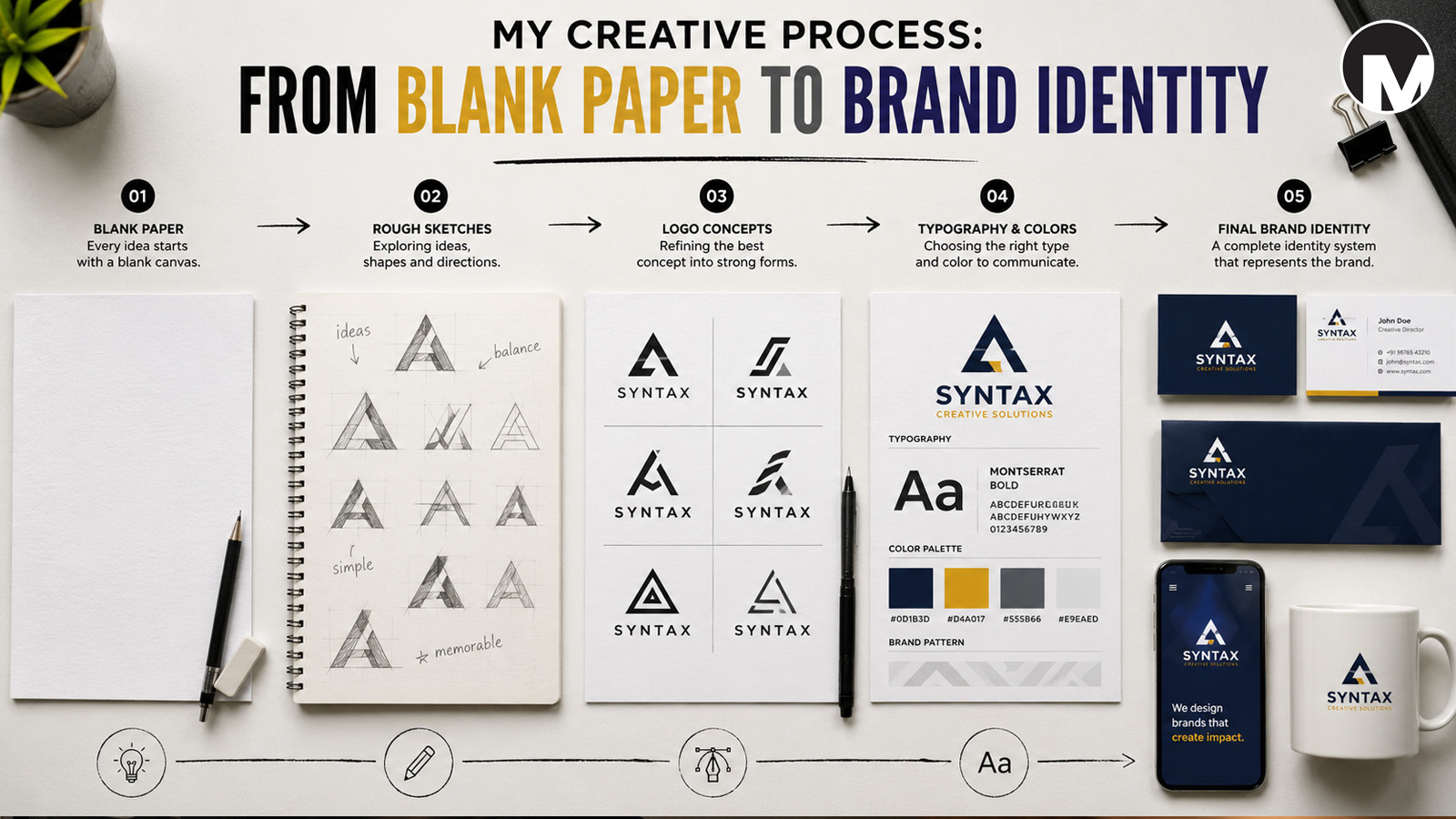
Every design project begins with a blank page.
At first, there may be no logo, no colors, no typography, and no clear visual direction. There is only an idea, a business, and a problem that needs to be solved.
For me, the creative process is about turning that starting point into a clear and meaningful visual identity.
At Manas Graphics, I don’t believe good design happens by simply opening Illustrator and starting to draw. It begins with understanding, research, ideas, exploration, and communication.
Here is how I approach a brand identity project.
1. Understanding the Business
Before designing anything, I first try to understand the business.
Every business has its own purpose, audience, personality, and goals. A design should reflect these things rather than simply look attractive.
I ask questions such as:
- What does the business do?
- Who are its customers?
- What makes it different?
- What kind of personality should the brand have?
- Where will the design be used?
- What should people feel when they see it?
These questions help establish a direction before the actual design begins.
Good design starts with understanding the problem.
2. Research and Observation
Once I understand the business, I look at its industry, competitors, audience, and visual environment.
Research helps me understand what is already being done.
I look at existing logos, colors, typography, layouts, imagery, and visual styles within the industry. This gives me an idea of what works, what is common, and where there may be an opportunity to create something different.
The purpose of research isn’t to copy what already exists.
It is to understand the visual landscape before creating something new.
3. Finding the Creative Direction
After research, I start developing a creative direction.
This is where ideas begin to take shape.
I think about words, concepts, shapes, visual characteristics, colors, typography, and possible ways to communicate the personality of the brand.
Sometimes the direction is clear immediately.
Sometimes it takes several ideas before finding the right one.
This stage is about exploration rather than trying to create the perfect design immediately.
4. Sketching Ideas
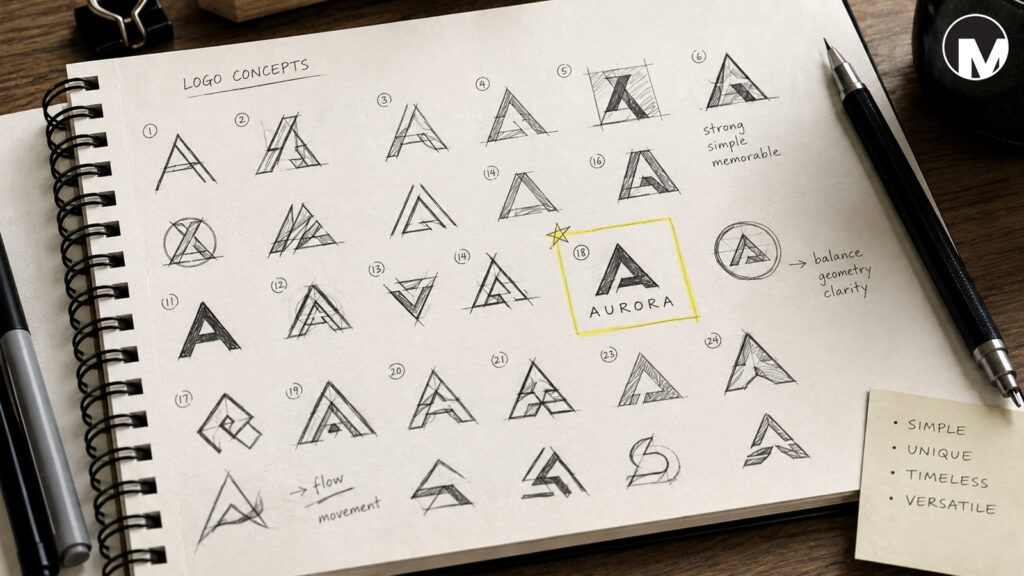
Before moving completely into digital design, I like to explore ideas through sketching.
A sketch doesn’t need to look perfect.
The purpose of sketching is to quickly explore possibilities.
I can experiment with shapes, symbols, compositions, letterforms, and concepts without worrying about technical details.
The blank paper becomes a space where different ideas can exist.
Some sketches may be weak.
Some may lead nowhere.
But occasionally, a simple sketch can become the foundation of the final design.
5. Moving from Paper to Digital
Once I find promising ideas, I begin developing them digitally.
This is where I refine the concept using tools such as Adobe Illustrator.
The initial sketch is not necessarily the final design. It becomes a starting point.
I work on proportions, geometry, spacing, typography, composition, and visual balance.
Digital design allows me to test different possibilities and refine the idea until the design becomes clearer and more precise.
The goal isn’t to make the design complicated.
It is to make the idea work.
6. Exploring Typography and Color
Typography and color become important parts of the identity at this stage.
The typeface needs to support the personality of the brand.
A modern technology company may need a very different typographic character from a rock music brand, restaurant, or creative studio.
The same applies to color.
Color can influence how a brand feels and how people perceive it.
I experiment with different combinations while keeping the overall personality and purpose of the brand in mind.
Every visual choice should have a reason.
7. Creating the Complete Identity
A logo is only one part of the process.
Once the main visual direction is established, I think about how the identity will work across different applications.
This can include:
- Business cards
- Websites
- Social media
- Packaging
- Stationery
- Marketing materials
- Presentations
- Digital graphics
The identity needs to work as a system rather than as an isolated logo.
A successful identity should remain recognizable even when the application changes.
8. Reviewing and Getting Feedback
Design doesn’t always become perfect in the first attempt.
Review and feedback are important parts of the process.
I communicate with the client, present the direction, listen to feedback, and make necessary improvements.
The purpose of feedback isn’t simply to make random changes.
It is about understanding whether the design communicates the intended message and whether it works for the business.
Good communication helps turn the design process into a collaboration.
9. Refinement
After feedback, I refine the design.
This may involve adjusting typography, spacing, colors, proportions, composition, or individual elements.
Small changes can make a significant difference.
A logo may look almost right, but a small adjustment to spacing or proportion can make it feel much more balanced.
This stage is about paying attention to details without losing sight of the bigger idea.
10. Building the Final Brand Identity
Once the design direction is finalized, the different elements come together into a complete visual identity.
The logo, colors, typography, graphic elements, imagery, layouts, and applications should feel like they belong to the same brand.
This is where the original idea from the blank page becomes a complete visual system.
The final result should not only look professional.
It should communicate the personality of the business clearly and consistently.
From Blank Paper to a Brand
The creative process may look different for every designer and every project.
For me, it is a combination of understanding, research, thinking, sketching, designing, communicating, and refining.
A good identity doesn’t appear instantly.
It develops through a series of decisions.
The blank page is simply the beginning.
From there, ideas become sketches. Sketches become concepts. Concepts become designs. And designs become a visual identity that represents a business.
At Manas Graphics, I believe the best design comes from combining creativity with a clear direction.
Because design is not just about creating something that looks good.
It’s about turning an idea into something people can see, recognize, and remember.