
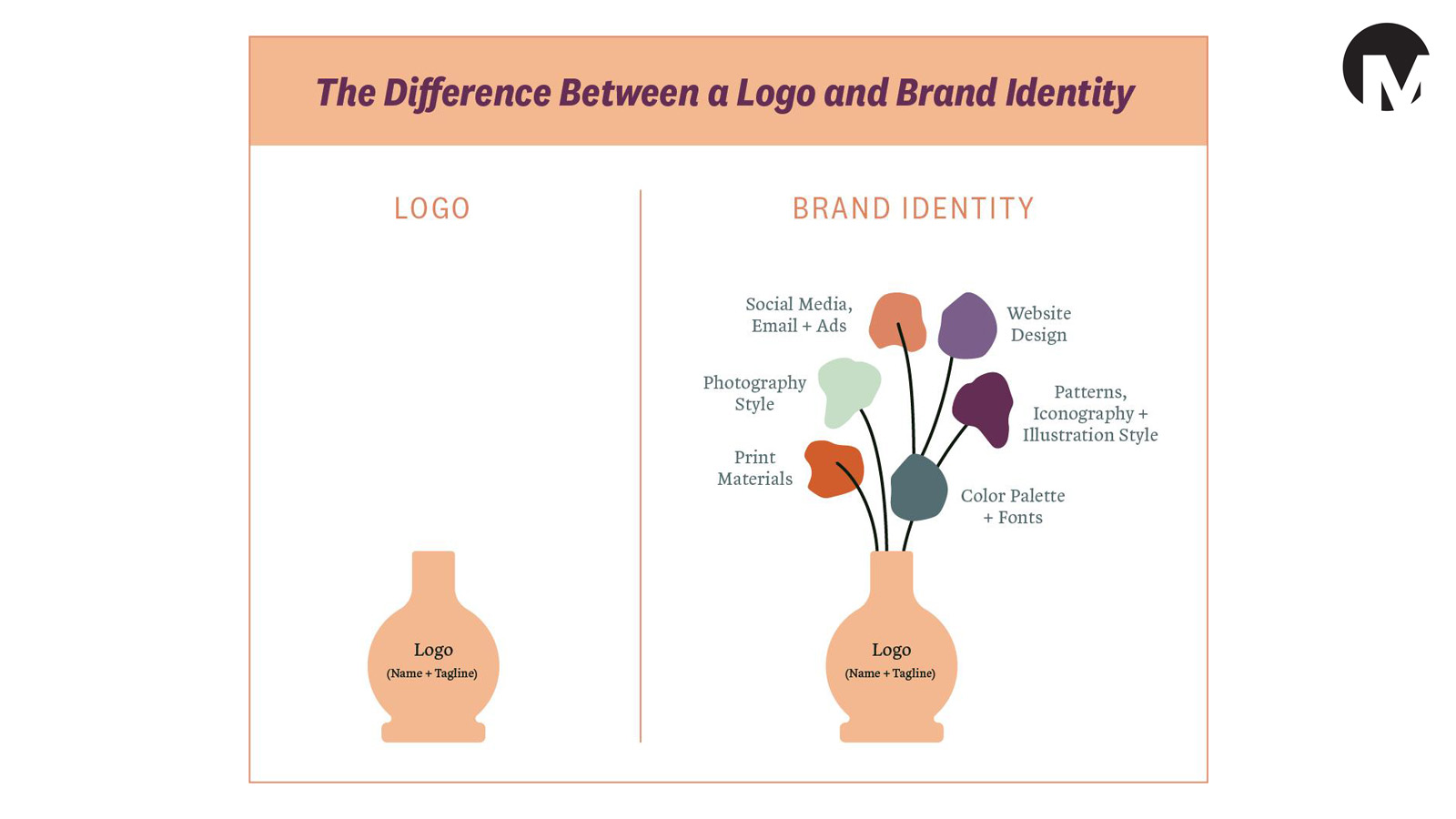
When people talk about branding, three words often appear together: logo, brand, and brand identity.
They are sometimes used as if they mean the same thing.
But they don’t.
A logo is not a brand. A brand is not simply a collection of colors and fonts. And brand identity is much more than placing a logo on different materials.
Understanding the difference between these three concepts is important for both designers and business owners.
At Manas Graphics, I see them as three connected parts of a much bigger picture.
1. What Is a Logo?
A logo is a visual symbol that identifies a business, product, organization, or service.
It can be a wordmark, symbol, monogram, combination mark, or another form of visual identifier.
Think about some of the world’s most recognizable companies. Their logos allow people to quickly identify them.
But a logo has an important limitation:
A logo alone cannot communicate everything about a business.
It cannot completely explain the company’s personality, values, customer experience, products, communication style, or reputation.
A logo is an important part of a brand, but it is only one part.
A logo helps with:
- Recognition
- Identification
- Visual representation
- Memorability
- Consistent brand recognition
A well-designed logo should work as a strong foundation for the visual side of a business.
2. What Is a Brand?
A brand is the overall perception people have of a business.
This is where the concept becomes much bigger than graphic design.
A brand is shaped by everything people experience when they interact with a business.
It can include:
- Products and services
- Customer experience
- Communication
- Reputation
- Company values
- Personality
- Advertising
- Website
- Social media
- Packaging
- Employees
- Overall experience
Imagine two businesses selling similar products.
One provides excellent service, communicates professionally, has a consistent visual presence, and creates a memorable customer experience.
The other has poor communication and inconsistent experiences.
Even if both businesses have attractive logos, people may develop completely different opinions about them.
That perception is part of their brand.
So, a simple way to think about it is:
Logo = what identifies you visually.
Brand = what people think and feel about you.
3. What Is Brand Identity?
Brand identity is the visual and verbal system created to represent a brand consistently.
This is where graphic design plays a major role.
A brand identity can include:
- Logo
- Color palette
- Typography
- Photography style
- Illustration style
- Graphic elements
- Iconography
- Layout system
- Packaging
- Business cards
- Website design
- Social media graphics
- Marketing materials
- Brand voice and communication style
The goal is to make these elements work together as one recognizable system.
For example, if a company has a bold and energetic personality, its typography, colors, imagery, layouts, and graphic elements should support that personality.
The identity becomes a visual language for the brand.
4. How They Work Together
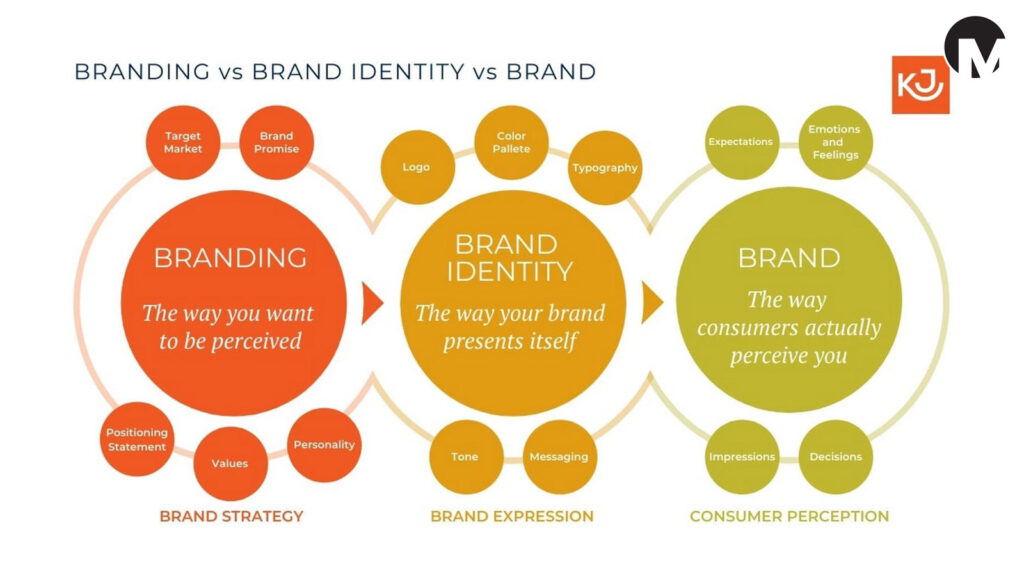
The easiest way to understand the relationship is to imagine a person.
Your logo is like a person’s face or recognizable appearance.
Your brand identity is like the way that person dresses, speaks, presents themselves, and communicates.
Your brand is the overall impression people develop after interacting with that person.
They are different, but they work together.
Logo
Identifies the business.
Brand Identity
Expresses the business visually and consistently.
Brand
Represents the overall perception and experience of the business.
5. Why a Logo Alone Isn’t Enough
One of the most common mistakes businesses make is thinking:
“We have a logo, so we have a brand.”
Having a logo is a good beginning, but it doesn’t automatically create a strong brand.
Imagine seeing the same logo used with:
- Different colors every time
- Random fonts
- Inconsistent layouts
- Poor-quality images
- Different visual styles
- Different communication styles
The logo may remain the same, but the overall presentation feels inconsistent.
Now imagine that the same logo is supported by a consistent color palette, typography, imagery, layouts, graphics, and communication style.
The business immediately becomes easier to recognize.
This is the power of a brand identity system.
6. Logo vs Brand Identity
A logo is usually a single visual identifier.
A brand identity is a complete system.
For example:
Logo
→ Symbol or wordmark
Brand Identity
→ Logo
→ Colors
→ Typography
→ Imagery
→ Illustrations
→ Graphic elements
→ Layouts
→ Packaging
→ Website
→ Social media
→ Marketing materials
The logo should be able to exist independently, but it should also work as part of the larger identity.
7. Brand Identity Creates Consistency
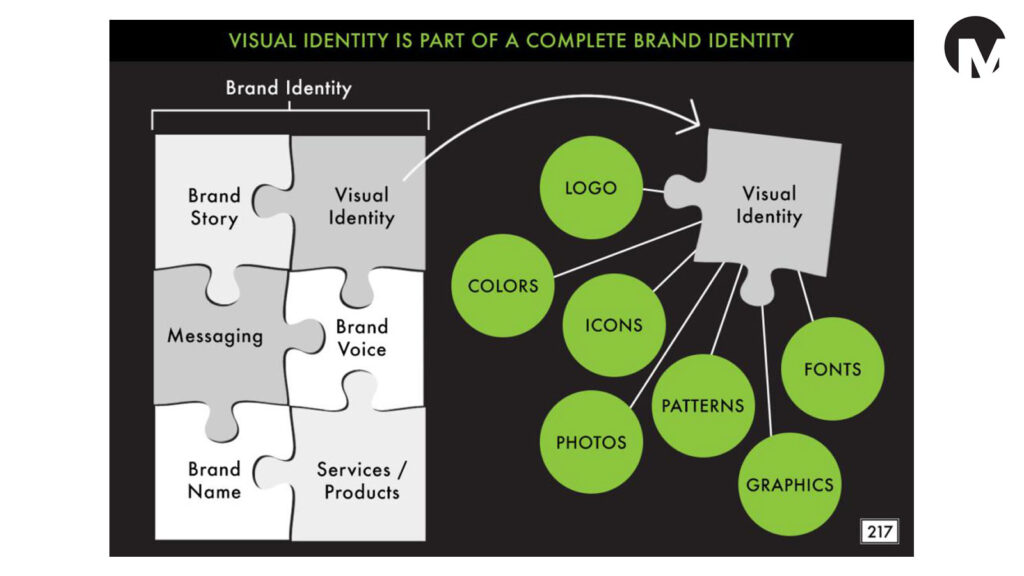
Consistency is one of the most important functions of a brand identity.
When people see the same visual language across different touchpoints, they begin to recognize the business more easily.
A customer might encounter a company through:
Instagram → Website → Business Card → Packaging → Advertisement
Even though these are different applications, they should still feel like they belong to the same business.
That’s what a strong identity system helps achieve.
8. A Simple Example
Imagine a fictional company called North Studio.
Its logo is a simple geometric wordmark.
But the complete identity could include:
Logo:
A clean geometric wordmark.
Colors:
Black, white, and a distinctive accent color.
Typography:
A modern sans-serif typeface.
Photography:
Minimal, high-contrast architectural photography.
Graphics:
Simple geometric shapes.
Website:
Clean layouts with generous spacing.
Social Media:
Consistent typography, colors, and graphic compositions.
The logo identifies North Studio.
The brand identity creates its visual language.
And the brand is the overall impression people develop from experiencing North Studio.
9. The Designer’s Role
As a graphic designer, my job isn’t simply to create a logo that looks attractive.
The bigger challenge is understanding what the business needs to communicate.
I need to think about:
- Who is the audience?
- What does the business represent?
- What makes it different?
- What personality should it have?
- Where will the identity appear?
- How can the visual system remain consistent?
- How can people recognize it?
This is why branding requires more thinking than simply designing a symbol.
The design needs to solve a communication problem.
10. The Three Concepts at a Glance
| Concept | What It Means |
| Logo | A visual identifier for the business |
| Brand Identity | The visual and verbal system used to represent the business |
| Brand | The overall perception and experience people have of the business |
Understanding this distinction can completely change the way you approach branding.
From Logo to Brand
A logo can be the starting point.
But a strong brand needs more than a symbol.
It needs a clear personality, consistent communication, meaningful visual choices, and a positive experience.
Logo → Brand Identity → Brand Experience → Brand Perception
These elements work together to create something that people can recognize, understand, and remember.
At Manas Graphics, I believe good branding begins by understanding the difference between simply creating a logo and building a complete visual identity.
Because a logo may identify a business.
But a strong identity helps people recognize it.
And a strong brand gives them a reason to remember it.